The GC Fuji Oyama Factory in Japan, forms part of the company’s international production network and is located near Mount Fuji. (All images: GC Europe)
LEUVEN, Belgium: Whether it is a sophisticated composite or an advanced adhesive, every new dental product must be safe, precise and reliable. At GC, bringing such an innovation to market involves a global development cycle—from the initial idea and market research in Europe to research and development in Japan and, ultimately, market readiness.
Each innovation begins with a central consideration: how to make dental treatment more effective, predictable and straightforward. To identify areas for improvement, GC’s global marketing teams maintain close contact with dental professionals. Collaboration with universities, surveys of dentists in private practice and expert panels help identify unresolved challenges in daily practice.
Listening to the market and identifying ideas
One important forum for this dialogue is the GC Europe Restorative Advisory Board. Established in 2010, the board provides valuable input from clinical practice. This process helps GC identify opportunities to improve existing products, address gaps in digital and analogue workflows and consider findings from basic research that could inform product development.
The ideas gathered are reviewed by GC International in Lucerne in Switzerland, together with the company’s regional teams. These teams assess whether new product concepts address the needs of individual markets. When an idea has international potential, the product design and technical specifications are defined in collaboration with the research and development team in Japan.
The GC Europe Restorative Advisory Board brings together dental professionals from Europe and the Middle East to provide clinical input on restorative materials and workflows.
Research and rigorous practical testing
GC’s roots lie in Tokyo, where three young Japanese chemists established the GC Chemicals Research Laboratory in 1921, laying the foundation for the company. Today, more than 100 scientists work on new dental technologies at GC’s state-of-the-art research facilities in Japan.
Once an initial formulation has been developed, it undergoes extensive laboratory testing. Prototypes must demonstrate the required physical properties and perform reliably under practical conditions. Dentists and dental technicians are therefore involved at this stage to assess aspects such as handling and application from a clinical perspective. According to GC, this approach applies both to new products and to improvements to existing products.
GC’s research and development centre in Japan, supports the development and testing of dental materials.
Meeting European regulatory requirements
Once testing has confirmed the formulation, the process of meeting the requirements for placing the product on the European market begins. The manufacturer compiles technical documentation, which may include testing of the product’s physical and mechanical properties, evidence relating to biological safety and biocompatibility and clinical data or a clinical evaluation, as applicable. Once the conformity assessment has been completed, the manufacturer draws up the EU declaration of conformity and affixes the CE marking, allowing the product to be placed on the EU market.
Preparing for launch and maintaining quality
Preparing for a market launch requires each stage to be carefully coordinated. According to GC, packaging and instructions for use are finalised in 27 languages as production begins at selected locations around the world. One key site in the company’s production network is the specialised GC Fuji Oyama Factory near Mount Fuji in Japan.
Detailed case studies, step-by-step guides and manuals are developed with dental experts, and field teams receive clinical and product training. At the same time, stock is supplied to distributors ahead of the launch to support product availability for customers.
Quality monitoring continues after the product has entered the market. GC monitors product quality from the initial laboratory formulation through to clinical use. Its post-market surveillance system collects and reviews customer feedback and other information to monitor the product’s continued safety and performance and identify whether further action is required.
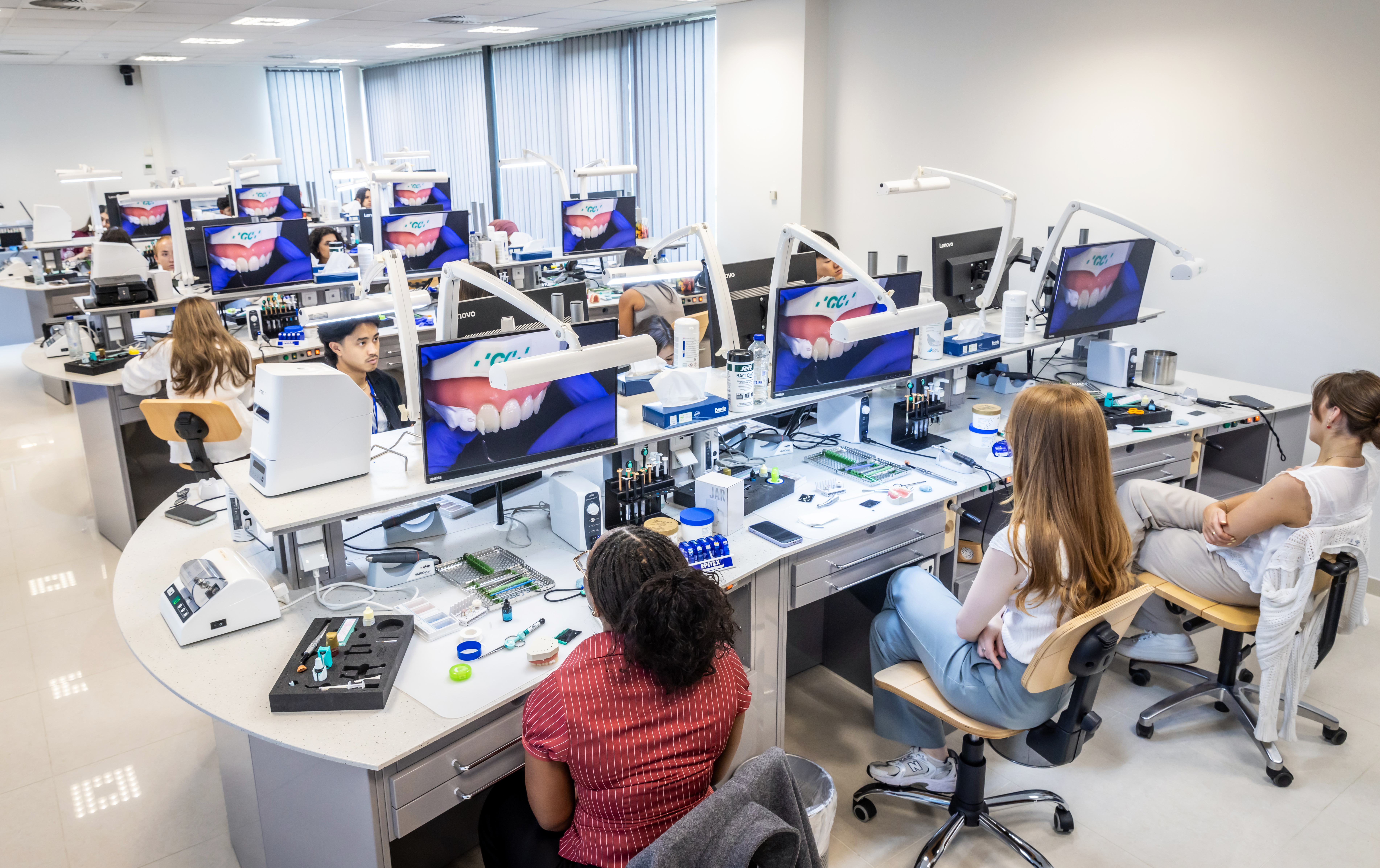
Dental professionals take part in hands-on training at GC Europe Campus in Belgium.
Clinical support and Vision 2031
Once a product becomes available, GC consultants visit dental practices and laboratories to present it and demonstrate its use. The company also offers practical training and continuing education for dentists and dental technicians across Europe. A central hub for these activities is the GC Europe Campus in Leuven in Belgium, where dental professionals receive hands-on training in products and clinical techniques.
This approach supports the company’s long-term strategy—Vision 2031. Announced on GC’s 100th anniversary in 2021, the vision is for GC to become “the leading dental company committed to realising a healthy and long-living society”. The strategy is not focused solely on sales volume but also emphasises sustainable growth and the value the company aims to provide to dental care and wider society. More information about the company can be found at www.gc.dental.
As restorative dentistry shifts focus from core operative procedures to individual patient needs and values, the demand for holistic patient care for ...
TOKYO, Japan: Leading dental manufacturer GC Corp. has invited global dental professionals to save the date for its sixth International Dental Symposium, ...
LEUVEN, Belgium: GC Europe, a leading oral health company supplying dental products and services to dental professionals, is emphasising the importance of ...
Molar incisor hypomineralisation (MIH), recognised as a clinical condition since 2001, is a common developmental enamel defect affecting the first permanent...
LEUVEN, Belgium: GC Corporation is marking a special anniversary in the dental world this year as it looks back on 105 years of history. What began in 1921 ...



 International / International
 Brazil / Brasil
 Canada / Canada
 Latin America / Latinoamérica
 USA / USA
 Austria / Österreich
 Bosnia and Herzegovina / Босна и Херцеговина
 Bulgaria / България
 Croatia / Hrvatska
 Czech Republic & Slovakia / Česká republika & Slovensko
 France / France
 Germany / Deutschland
 Greece / ΕΛΛΑΔΑ
 Hungary / Hungary
 Italy / Italia
 Netherlands / Nederland
 Nordic / Nordic
 Poland / Polska
 Portugal / Portugal
 Romania & Moldova / România & Moldova
 Slovenia / Slovenija
 Serbia & Montenegro / Србија и Црна Гора
 Spain / España
 Switzerland / Schweiz
 Turkey / Türkiye
 China / 中国
 India / भारत गणराज्य
 Pakistan / Pākistān
 Vietnam / Việt Nam
 ASEAN / ASEAN
 Israel / מְדִינַת יִשְׂרָאֵל
 Algeria, Morocco & Tunisia / الجزائر والمغرب وتونس
 Middle East / Middle East


 Dr. Pierre Marin, Dr. Antoine PopelutRegister now1CELive webinar
 Dr. Sinan GhishanRegister now1CELive webinar
 Dr. Sonia PresenciaLive webinar
 Dr. John Tsourounakis DDS, Cert. Perio, MS, FRCD(C)Register now1CE


















To post a reply please login or register