Search Dental Tribune

From left: Dr Ivo Krejci, honorary professor at the University of Geneva in Switzerland; Dr Laura Ceballos García, professor at Rey Juan Carlos University in Madrid in Spain; Prof. Roland Frankenberger, head of the Department of Operative Dentistry at Philipps University Marburg in Germany; and Prof. Marleen Peumans, Department of Oral Health Sciences at KU Leuven in Belgium. (Image: OEMUS MEDIA)

Wed. 4 November 2026

save

Universal adhesives have become an established part of restorative dentistry, offering simplified application procedures and increasingly reliable clinical performance. In this interview, Profs. Laura Ceballos García, Roland Frankenberger, Ivo Krejci and Marleen Peumans discuss the clinical evidence, key considerations in adhesive selection and future developments in dental bonding.

What are the main criteria for you to choose your adhesive? Do you use different types of adhesives for different indications?
Ceballos García: I consider that we should select our adhesive according to the best scientific evidence available. It would be advisable to use an adhesive that has been tested in randomised clinical trials and has obtained adequate and consistent results. Therefore, the clinical performance would be as independent of operator skills as possible. Of course, we should also feel confident with its application mode and not encounter premature clinical problems such as postoperative sensitivity. I try to use the same adhesive for all clinical procedures.

Frankenberger: As I have been testing every adhesive on the market since 1994, the question is easy. When an adhesive “survives” our range of in vitro investigations, including chewing simulation, deep-cavity microtensile testing and handling tests, I am free to use it. Normally, I tend to use the same adhesive for every indication and do not differentiate.

“Today, universal adhesives offer good performance and low technique sensitivity, which is excellent.”

Prof. Roland Frankenberger

Krejci: Efficiency, ease of use and low handling sensitivity are the most important factors. I also prefer using just one universal one-component adhesive that is suitable for all indications.

Peumans: For me, the most important criterion is the bonding efficiency of the adhesive system in vitro and in vivo. I still tend to rely on a three-step etch-and-rinse adhesive, especially in cases where it is difficult to determine whether dentine has been exposed on the prepared tooth surface, for instance, with veneer preparations. When I can clearly identify where dentine and enamel are located, I use a two-step self-etch adhesive system with prior selective enamel etching. Either way, I always etch the enamel with 35% phosphoric acid to increase micromechanical retention.

Nowadays, universal adhesives containing the 10-MDP functional monomer also perform very well in vitro when used in a two-step self-etch mode. This involves adhesive application, air-thinning, polymerisation and application of a hydrophobic resin or flowable composite. G2-BOND Universal is one example of such an adhesive. However, long-term clinical trials are not yet available.

GC launched its first one-bottle self-etch system, G-BOND, in 2004. Your research group was one of the first to evaluate it in a clinical trial. For how long have you now had clinical feedback on this product?
Peumans: We completed a 14-year clinical trial in which we evaluated the bonding efficiency of G-BOND from GC and OptiBond FL from Kerr in non-carious cervical lesions.1

According to the research you conducted, what is the clinical performance?
Peumans: After 14 years, restorations bonded with the HEMA-free one-step self-etch adhesive G-BOND performed as well as those bonded with the three-step etch-and-rinse “gold standard” OptiBond FL. Unacceptable marginal deterioration or severe marginal discoloration were the main reasons for failure, followed by loss of retention.

The overall clinical success rates were 58.9% and 57.9% for G-BOND and OptiBond FL, respectively. The overall clinical performance was not significantly different between the two adhesives. Changes in the medical health of some patients and recurrence of abrasion, erosion or abfraction reduced the success and retention rates.

How important is the thickness of the bonding layer and why? In relation to that, how important is the radiopacity of a bonding system?
Frankenberger: Unfilled adhesives may cause issues when the layer is too thick because they can appear as a gap on a radiograph. Therefore, I prefer adhesives with low film thicknesses. When this is achieved, radiopacity does not play a major role. It may only be of interest when we bond to caries-affected dentine, where hybrid layers can be quite thick.

“The evidence is growing that contemporary universal one-component adhesive systems perform as well as traditional multistep adhesives.”

Prof. Ivo Krejci

Peumans: If the adhesive has a film thickness below 10 μm, which is often the case with universal adhesives, there is an increased risk of suboptimal stabilisation of the adhesive interface and a reduced ability of the adhesive layer to absorb stress caused by the overlying shrinking restorative composite. In addition, polymerisation of a very thin adhesive layer is suboptimal due to oxygen inhibition. Radiopacity is therefore important to avoid misinterpretation of recurrent caries beneath the restoration, especially when the restoration is evaluated by another dentist.

Krejci: I believe the optimal situation lies somewhere in the middle. The physical properties of an adhesive system are inferior to those of a highly filled restorative composite, so thick adhesive layers may compromise the biomechanical properties of the restorative system. Therefore, the adhesive layer should be as thin as possible, but thick enough to allow complete coupling with the restorative composite. Radiopacity is advantageous if an adhesive system has been placed in a thicker layer for any reason or if pooling occurs, for example, in cavity angles.

Currently, there is an increased trend towards universal single-bottle bonding agents. What is the evidence for their success rate? What is your personal understanding of a universal approach?
Peumans: A universal adhesive is an improved one-step self-etch adhesive that can be applied in several modes: etch-and-rinse, self-etch or selective enamel etching. In addition, these adhesives can chemically bond to various restorative substrates.

Their use is increasing because of their ease of application and the possibility of using different application strategies. Regarding bonding efficiency, these adhesives perform quite well in in vitro bond strength tests. Moreover, they show good bonding efficiency when evaluated in clinical studies of non-carious cervical lesions, especially when at least the enamel is etched with phosphoric acid.

Ceballos García: Unfortunately, the number of clinical reports available on adhesive performance is still not as high as we would like, as these studies are very difficult to conduct. Universal adhesives have been available on the market for more than ten years, although only a few clinical studies have evaluated their long-term performance, mainly after five years of clinical service.

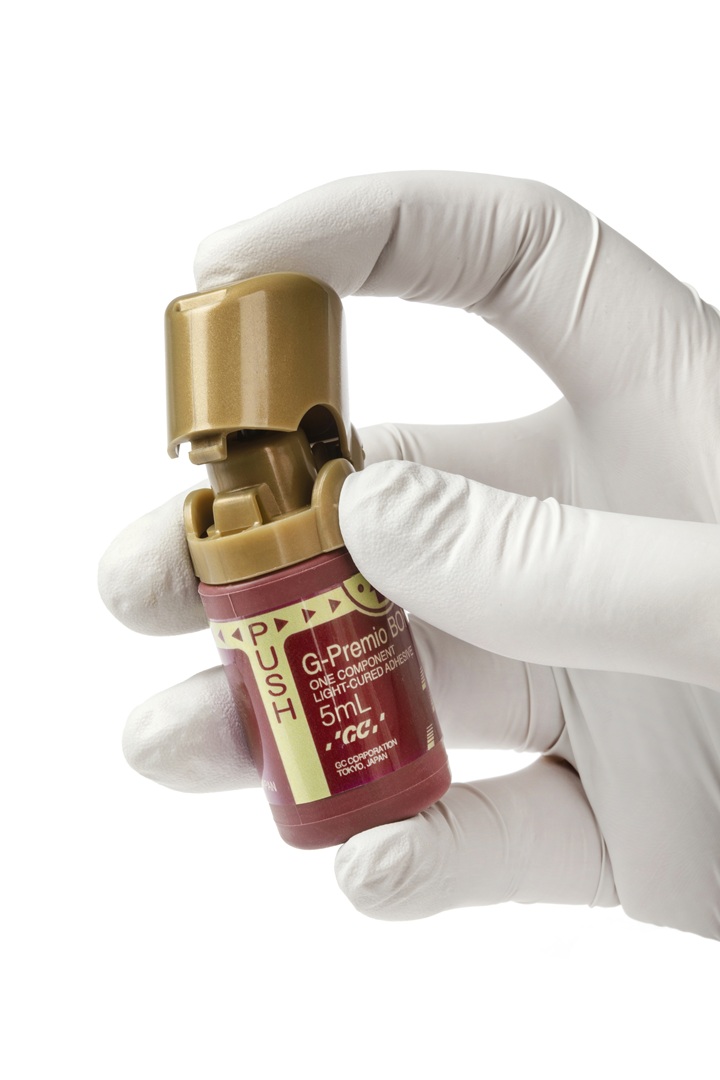
G-Premio BOND from GC is a one-bottle universal adhesive compatible with all etching modes. It is suitable for direct bonding procedures, restorative repairs and the treatment of dentine hypersensitivity. (Image: GC Europe)

G-Premio BOND from GC is a one-bottle universal adhesive compatible with all etching modes. It is suitable for direct bonding procedures, restorative repairs and the treatment of dentine hypersensitivity. (Image: GC Europe)

According to these studies, the retention rate of restorations in non-carious cervical lesions is above 80% for the adhesives tested and even higher when enamel margins are previously etched with phosphoric acid.

Frankenberger: After several years of clinical use, I believe that universal adhesives have reached a very high clinical standard. I use them all the time.

Peumans: However, bonding efficiency is material-dependent and subject to hydrolytic degradation. The long-term clinical performance of universal adhesives still needs to be proven.

Krejci: To me, a universal approach means that the adhesive system performs well on enamel, dentine, composite and ceramic surfaces in a single application without additional treatment steps. The evidence is growing that contemporary universal one-component adhesive systems perform as well as traditional multistep adhesives.

Ceballos García: There is a recent clinical report in which G-Premio BOND was evaluated, and the survival rate of cervical restorations performed with this adhesive was 96.5%.2

What does the evidence show about HEMA-free bonding agents, such as G-BOND and G-Premio BOND?
Krejci: HEMA is a small molecule that may cause allergic reactions, which is why HEMA-free adhesives are gaining ground. Although it is incorporated into most adhesives, there is no evidence that HEMA is indispensable for achieving good adhesion.

Ceballos García: HEMA-free adhesives are less hydrophilic and consequently result in lower water sorption and reduced hydrolytic degradation of the adhesive layers.

Peumans: A systematic review of clinical trials showed that HEMA-free and HEMA-containing adhesive systems demonstrated similar clinical performance in these restorations. This was also confirmed in the in-house long-term 14-year clinical trial that I mentioned previously.

Frankenberger: The secret to their clinical success is definitely not the fact that they are HEMA-free; however, it is nice to have this feature.

“We should seek adhesives that can modify the biofilm, reduce its cariogenicity, prevent secondary caries or provide remineralising properties.”

Prof. Laura Ceballos García

What is your opinion about the use of bonding agents as restoration primers for indirect restorations?
Frankenberger: In this case, I still tend to use separate silanes or metal primers.

Peumans: I agree. It has been clearly demonstrated in vitro that the separate application of silane to the indirect restoration, followed by application of the adhesive, results in higher and more durable bond strength to the indirect restoration compared with the application of an adhesive system that incorporates silane. Therefore, we still recommend applying silane and the adhesive in two separate steps.

What do you think is the next step in the field of bonding? Where is the science heading?
Krejci: Self-adhesive restorative composite materials.

Peumans: Indeed, there is a lot of research being conducted in this area. However, at present, the bonding efficiency of these self-adhesive materials is still below that of the gold-standard adhesive systems used in combination with composite materials. Adhesive bioactive materials are another area towards which science is moving.

Frankenberger: To be honest, I am glad that we have finally reached a good standard with relatively fast universal adhesives. For me, the most important aspect besides pure bonding performance is low technique sensitivity. This aspect has improved significantly since the first one-bottle systems.

Let me put it this way: we started with former gold-standard adhesives 30 years ago, but afterwards, the development moved in the wrong direction. Speed was prioritised over performance, leading to unacceptably high technique sensitivity, such as wet bonding approaches. This is now a thing of the past.

Today, universal adhesives offer good performance and low technique sensitivity, which is excellent. Of course, much is written about topics such as bioactive adhesives. However, these are only an option and not a fundamental prerequisite for future bonding systems.

Ceballos García: Yes, nowadays we have adhesive systems that are sufficiently effective for direct and adhesive indirect bonding procedures, allowing predictable clinical outcomes. Clinical failures are mainly the consequence of secondary caries or fracture of the restoration or tooth.

Therefore, we should seek adhesives that can modify the biofilm, reduce its cariogenicity, prevent secondary caries or provide remineralising properties. Self-adhesive resin composites are indeed another possibility. Either way, there is still a long way to go.

Frankenberger: Unfortunately, the EU Medical Device Regulation presents several obstacles to further developments, and clinical trials are much more complicated and expensive than they were in the 2000s. Therefore, I am not convinced that the development of new adhesives will continue at the same pace as it has until now.

Editorial note:

References

  1. Peumans M, Van de Maele E, de Munck J, van Landuyt K, Van Meerbeek B. Fourteen-year clinical performance of a HEMA-free one-step self-etch adhesive in non-carious cervical lesions. J Adhes Dent. 2023;25(1):147–58. doi: 10.3290/j.jad.b4208859.
  2. Oz FD, Ozturk C, Soleimani R, Gurgan S. Sixty-month follow up of three different universal adhesives used with a highly-filled flowable resin composite in the restoration of non-carious cervical lesion. Clin Oral Investig. 2022 Aug;26(8):5377–87. doi: 10.1007/s00784-022-04505-x.
Tags:
To post a reply please login or register
advertisement
advertisement